Thoughts on my research for 1-2-1 tutorial.

4/06/19

I’ve been thinking about what work and questions I should take to discuss at my tutorial this week. I’ve realised we only have a few weeks left of term so I’m better off focusing on the one piece I’m working on with the film positives and the fold out series of Claire applying her make up rather than desperately trying to produce work for the sake of it. These images have potential to be further developed with intaglio processes.

I’ve decided I’m going to let the work guide the idea of beauty as a form of religion (a cult of beauty, women made to believe they can’t fully socially function without it) and see where it goes as it’s coincided with my reading of Naomi Wolf on religion and the beauty myth and obviously resonating with me.

I’m also going for quality over quantity at this stage and giving myself the space to do a decent amount of research for my paper by not desperately trying to produce work for the sake of it. Unless the ideas are generated from what I’m currently doing.

Goffman is filtering slowly through my mind in regards to my research paper and I’m interested in investigating the idea of the performative nature of femininity and masculinity (Grayson Perry’s Descent of Man maybe relevant here). This relates back into my images of Claire as a religious icon and the performative nature of the putting on of makeup being a part of the construction of her social identity.

But my question is how I formulate this into a paper that helps to reveal new ideas/thoughts about the artists I feel are relevant and relate back to my work. The artists and art needs to exemplify my ideas.

Goffman also did a lot of participant observation which is something I’d like to investigate tools a part of my research. I’ll need help formulating the where and when of that.

Do identities whether of race, gender or religion get reduced by this repetitive act of performance? And can I express this through my work. Maybe I already am in the repetition of the same figures in my work. Of Alex, Claire and myself in the etchings and drypoints I’ve been producing.

Three images that use repetition to emphasis identity and perhaps the politics of identity.


I’d like to think more about the process within which I’m expressing these ideas and I really like the idea of producing masks. I’m not sure how these will function, but the exterior surface layer reproduced. Maybe an inside as well as the outside to my mask, revealing deeper layers of meaning. Will these express how identities get reduced or the actual real complexities of identity.

Photograph of Barton and her huge mask sculpture photographed by Mayotte Magnus.

Identities get reduced, reproduced and misunderstood, art can and does challenge many incorrect assumptions. I think the sculpture of Glenys Barton, photography of Jo Spence and painting of Jenny Saville are brilliant exemplifiers of art challenging misunderstood/stereotyped identity by emphasising multiplicity and the social context of personality (Jo Spence) or by graphically revealing the effects of stereotyping (Savilles work).

We all have many identities that perform different social functions even if we identity as a woman, man, Jew, Christian, young, old, black or white. This feeds back into Kwame Anthony Appiah’s writing on identity.

These are all areas for me to investigate for my research and I’ll take some of this to my tutorial! How this slots into my own works remains a mystery.

‘Thinking Allowed’ Beauty-Ugliness

[From Wed 18 July 2018]

BBC Radio 4

Notes for later reference.

Heather Widdows-professor of Global Ethics at the University of Birmingham.

Her latest book explores beauty as an ethical ideal, how beauty has become a moral question that is being naturalised cross-culturally into a global ideal of the ‘perfect me’.

She discusses how the beauty ideal is gradually converging. Local ideals of beauty aren’t all the same, but they are slowly converging into this global ideal that consists of thinness, firmness and smoothness. Which she argues comes from the “selfie” culture and the impossible images social media portray. She calls it the “forensic gaze”.

We no longer discuss being a better person in terms of our morality but being better in terms of our physical selves.


This is more information and reference for my research paper. It suggests our identity is intrinsically caught up with our exterior physical appearance on a deep level. There’s a distinct correlation between the idea that if we’re successful in perfecting our bodies we’re more successful in our lives. Which is a pretty arbitrary correlation when you analysis it.

Ideal body = ideal life

End of week roundup

30/05/19

Glenys Barton came up earlier in the year when I saw a striking photograph taken of her by Mayotte Magnus posing with a large mask like sculpture. I stumbled upon this at the National Portrait gallery. The black and white photos of all of the women appealed to me, but this image of Barton in particular. This mask is so emotive, which is reflected in the face of Barton, did she mean to make it a self-portrait?

I have also discovered Barton worked at Camberwell in the ceramic department. There’s such a rich legacy of artists that have worked in this college, it makes me feel extremely proud to be here.

It’s occurred to me this week that if I’m being encouraged to push my ideas and material testing in a non-linear direction then I’d love to make sculpture! And masks would be very appropriate. I like the idea of playing with the double sided nature of a mask. I was very focused on interior and exterior layers over the Easter break and I think it’s something I could take back up in a three dimensional form. It could even be easier to present the multiplicity of identity in this way. So my clay has been ordered and I’m reading more about Barton and her work on identity. I’ll be updating my thoughts on Barton for my work and potentially my research paper.

Glenys Barton photographed by Mayotte Magnus [NPG 2019]
Continue reading “End of week roundup”

Soft-ground etching

21/05/19

This is the first time I’ve done a soft-ground plate (zinc). I wanted to create a skin like texture. I crumpled tissue onto the soft-ground and wound it through the press. I like the result, it’s tactile and very skin like.

The idea was to then make the youngest head a light tone, then next darker and oldest figure darker still to mirror the aging process of each generation. The loose idea is that they are united and the same, yet all aging, but there’s a beauty in the aging and not something to mask or fight. Unfortunately the tonal range didn’t work so well. I didn’t leave the plate in the acid for long enough between stopping out.

I’ve also gone on to add a bit more texture by dry pointing into the plate, which I think has give it less of a monotone feeling. I did another soft-ground too and added a cheese cloth texture. Again it didn’t work that well because I rolled the ground a little too thick, but this was the point of this plate, to experiment. There might be their things I can do with it in the future. I like the idea of generations of women, my mum has been a huge source of support for me over the years and my oldest daughter is so similar to me in many ways, which pleases and worries me all at the same time.

Continue reading “Soft-ground etching”

Body World

4/04/19

I spent yesterday at the Body World exhibition in London. I got my anatomical fix, I like to understand what I’m drawing and it strangely coincided with how I see some of this work developing. The suspended blood vessels were beautiful and at the same time eerie. The reveal of layers of skin to expose what lies beneath is what I’ve been exploring from a different angle. Literally laying out the facts, here is what we’re made of, ‘the facts of life’. It’s a stark reminder that life will ultimately end in death, what we do in between is all there is. Getting caught up in the minutiae of life is a waste of time. Worrying about bodily imperfections is one of those minutiae. Our bodies are just amazing things, whether you feel your nose is too big or your chest too small is irrelevant to this miracle.

The human body is so fragile yet resilient, it’s a real contradiction. Humans are very good at over complicating thing with rules and regulations and filling it with inconsequential stuff!

Mono-print (lungs)

Me and My Dad. Thanks Louise Bourgois. And in other news…

7/03/19

My dad, his art. Not me.

Having just read a short piece on Louise Bourgois and her difficult relationship with her father, it’s really made me think I need to acknowledge and understand my “father issues” in order to free myself from them and even harness them. So much of my creative lockdown over the years are related to my frustrated relationship with my dad and his attitude to art and life. I drew inwards and took my creative potential with me. I have carved out some crazy idea of artistic purity and integrity as a consequence, which has done nothing but hold me back in my art and also in my life. It’s time I took some risks and really worked at that artistic freedom I have always craved.

It all comes back down to my creative identity, being brave and taking responsibility for my actions (or in-actions) in the past, but also moving forward. I can change things and not let my dad hold me back anymore. My dad gave me my creativity with one hand and took it with the other and its been my complete bind. If there’s one thing this MA can do for me, it’s shed me of that bind.

It’s like self-therapy this MA!

If I have defined my art through my father up to this point, how does this become significant to my work now? I don’t think there’s a one line answer to this question, but certainly one for contemplation.

Mid-point review: decision time

20/02/19

Having attended an academic support group with Victoria Ahrens, which was about our reflective journals and blogging. She emphasised that our journal entries must relate back to our own work and why whatever it is We’ve seen or read relates back to our work. I enjoy the explorative thinking with the journal and give me time to reflect on why I’ve done something.

So in the light of this I’ve thought harder about my mid-point review and decided I’m not really being true to my core reasons for being here, which is to pull together my interest in the anthropological and the art. There is something here for me that will be deeply satisfying and trying to be symbolic and construct some sort of significant piece of painting is just not working. Therefore, I am abandoning the acrylic painting of myself for now. I need to be doing work that feels right and not contrived.

Based on the success (in terms of how much I loved producing it) of my Woman with Figs etching I’ve decided to do an etching for the Mid-point review. I love the dark depths I can reach with the aquatint. Hopefully the content will develop from here on in. No more fairy tales for the moment.

I’m going to base my etching on some drawings I’ve been doing of my daughter Cléa, I want it to come out of my sketchbook in a much more organic way. I showed Tina, from Illustration, some of the sketches and she had some useful insight on the ones she preferred and why. Fresh eyes can be very helpful.

I aim to get a good tonal graduation with the aquatint tone, from light grey all the way through to a deep rich dark tone. That’s the aim anyway. Let’s see what I manage.

My final piece worked on some levels, I managed the aquatint and I love the darkness of the black. Unfortunately I don’t think my piece was understood in the way that I intended, but that makes for helpful feedback and I think I need to commit more to my subject matter. I meant for this image to be of a girl, but her gender be somewhat ambiguous and demonstrate the different multiple ways of “being” in one skin. The lilies were meant to be a little ironic, but this was all taken very literally, as the typical things girls like and that the footie boots were her boyfriends who she was staring out of the window waiting for! Ok not what I intended.

It’s quite funny on reflection, but I didn’t find it that funny at the time. I first image to be symbolic of a child on the cusp of adolescence staring out into the big wide world and assessing her chances as a girl (who plays a lot of football). And I’m not making this all up, this is how I see my daughter right now, that IS my daughter in the etching.

However, I’ve learnt first hand the ambiguity of any image. Making work with a clear concise message is not possible and not even desirable. It perhaps needs to be deeper than this image. I’m just not there yet.

Midpoint Review final piece

Portraits and Peter Blake

8/02/19

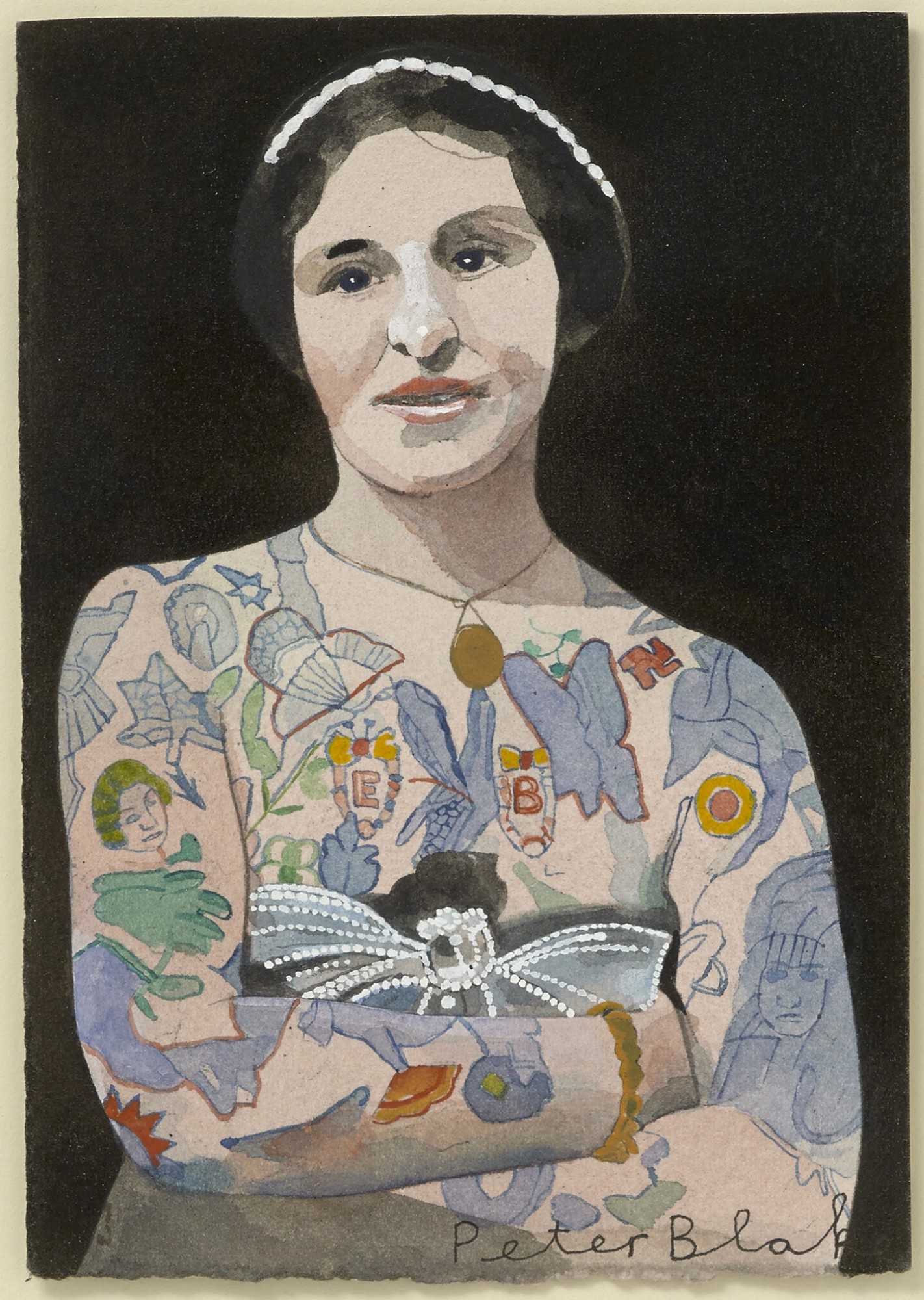
Peter Blake has been an artist who’s name has been repeated to me several times and I’ve really enjoyed getting to know his paintings. He’s been a part of the reason I decided to give acrylic portraits a go; it’s truly a combination of the watery nature of watercolour with the flexibility of overpainting as in oils.

Image result for peter blake
Related image

Peter Blake mixes bits of other media in with his skilful use of watercolour, acrylic and oil paint. Why I think I’ve been recommended to look at his portraits more closely is because of the story he tells within a pretty classic portrait composition. I am not very good at the narrative thing, it doesn’t come naturally. I want my narrative to be about the person you’re looking at, their identity and how their story may relate to your story as the viewer. I also want to disrupt in some way using the portrait.

I guess this relates to why I’m still working on my ‘reflective self’ piece in acrylic, which is becoming more and more contrived. Thinking through and slowing down the process of producing work, as advised by Jan, is just not working, it all ends up as over-thought through crap. I need to develop how I produce work slightly differently, not sitting at a desk wracking my brains. My etching came out of my sketchbooks and didn’t feel contrived in any way. This is something worth thinking on.

Postscript…I’m going to see Peter Blake and Martin Gayford in conversation later this year at Charleston. I’m a big fan of Martin Gayford’s books so can’t wait for this.

Two terrible photos of Martin Gayford and Peter Blake.

It was a very casual, chatty discussion between the two of them, plotting the history of Peter Blake’s Pop art era and how he came to make some of his most iconic portraits.

The tea and cake afterwards was good too!

“All the world’s a stage”? Understanding Goffman’s Presentation of the Self in Everyday Life.

Term 3. 02/06/19

From http://www.timsquirrell.com

Look at symbolic interactionalism, coincides with Goffman’s thinking.

‘Seeing social life primarily as a function of interactions between people, groups, and institutions in particular contexts, and emphasising contexts, and emphasising the importance of symbols-of language, gestures, appearance-and the ways in which they shape our conceptions of the world around us and the actors in it’.

Participant observation as a key tool for his research, much like anthropologists.

Dramaturgical metaphor. Stage/actors etc but Squirrell notes not to take these terms too literally.

Check out Charles Cooley, ‘Looking Glass Self’ for more on the self in private.

This blog focuses on Ch. 1 Performances.

The basic idea of self-presentation is that our actions in social situations are all “acts”. Projecting a certain image of ourselves.

We also engage in impression management-projecting an idealised image of ourselves through our manner and appearance and the setting in which we situate ourselves.

Fronts-like a stage. Then there’s fixed elements of the front,

  1. Setting –the fixed elements of the front. Eg. The layout of a room.
  2. Appearance-things about us that we can’t easily change. Race, gender, age. Plus the items we carry with us and the clothes we are wearing.

Manner-

    more transient. Our attitude towards our setting, facial expressions etc.

The latter two Goffman calls the personal front.

Consistency would be expected between these but this isn’t always the case. Sometimes there is a lack of congruence.

Continue reading ““All the world’s a stage”? Understanding Goffman’s Presentation of the Self in Everyday Life.”

Mirror mirror…

6/01/19

I’m researching the fairytale. From an illustrative point of view there’s a lot of scope to retell and recast the traditional fairytale, not to mention the awful Disneyfication of fairytales. There’s so much doing on around female power, subjugation and the male gaze, to name but a few.

Fairytales are a microcosm of what society dictates and somewhat reflect and naturalise cultural norms. But historically they were subversive tales passed on orally, writers such as Angela Carter have reignited this subversive element of the fairytale with her book The Bloody Chamber. Challenging a Phallogocentric point of view.

Today, most fairytales seem to reinforce Western beauty ideals and the passive female, strongly reinforced by Disney and the like. Men are brave and heroic, women are beautiful and in need of rescuing. Women and girls seem to have little agency in the modern interpretation of fairytales. Recently Disney style fairytales have shown some strong female roles, such as in Brave and Repunzel, but when you hear parents at the school gate and teachers in the corridors it’s shocking how the basic premise of the above stereotypes are casually reinforced.